Saturday, April 01, 2006

The Hidden Secret of Life


John 12: 20-36

Did you catch the last part of the Gospel reading? It is easily missable, tucked away as an after thought, almost as if John the evangelist is trying to plant a subliminal seed in our minds. I didn’t discover it until my umpteenth reading, buried there beneath the pile of confusing thoughts and apocalyptic overtones that Jesus is spouting out. But sure enough, right there at the end of Jesus’ speech about his death and his followers being honored by the Father, John confirms what we have all suspected at one time or another. Just when things are most confusing in life and we need God the most, God goes into hiding.
Take a look; it’s right there. Look back at our Gospel reading for today. How does it end? “After Jesus had said this, he departed and hid from them.” This is not the best time for Jesus to be hiding from his disciples. They have all just made their way back up to Jerusalem for their annual trek to participate in the Passover feast. But this year is different than the years before. He keeps dropping hints, like this was going to be their last year doing this. He kept talking about having to “give himself up,” and “do his Father’s will.” They tried to forget about it, but those seeds had taken root in their minds, and they were nervous about what was going to happen. When they entered Jerusalem this time, crowds were waiting for them, for him, waiving palm branches like he was a king, but he rode in on a donkey. Something just wasn’t right about this trip to Jerusalem and they knew it. Finally, the frightening plan starts to bud into fruition, and by the time we get to our reading for today, Jesus says flat out that he is going to die. “The time has come,” he says. And then, just when he drops this bombshell on his disciples, just when he scares them perhaps more than they have ever been scared in their lives, he leaves and he hides from them.
Why is it that God seems to go into hiding as we enter the most confusing and painful times in life? I have a friend who is trying to make a pretty big life decision. He has found himself at one of those crossroads that can affect the rest of his life. He figured that since it was Lent, and since it was a proper thing to do when seeking God’s will, he would fast while he prayed. Once a week, he decided, he would fast in order to try and discern what God’s will is for his life. I asked him last week what he was getting out of his weekly fasting. He said, “hungry.”
I know the feeling. Often my questions for guidance when I am confused, or my answers to thoughts of where is God in the midst of pain are left with an empty void. The question has been asked by much smarter people than me, “where is God when it hurts?” When life is going along pretty well and things are all looking okay, following God’s will isn’t all that difficult. But when it all takes a turn for the worse, and believe me, as some point it will, God seems to go into hiding. Just like Jesus did in John 12.
But what if he wasn’t so much hiding from them as he was hiding in them? Remember we are in John. Maybe that’s what John meant when he recalls Jesus saying “if you are my disciple, you are in me and I in you.” John states very plainly that Jesus, the Word, created everything that is. What’s more, when the Word created everything, he put a piece of himself in all. For John, Jesus, and God, are everywhere. There is no hiding when you are everywhere. So what if this Word who is the creator of everything, who made everything and is in everything, can’t really hide because he is everywhere? Is it possible that we miss God in those most painful or confusing times because God is too big to be seen, too present to be noticed? What if God’s hiding, rather than pointing to God’s absence, points to God’s ubiquity?
Maybe that’s what Jesus was talking about with this grain of wheat business. Molly and I spent all morning yesterday working in our yard. It was our first real yard day since we moved into our house, and the neighbors were practically standing on the curb applauding as we came out of the house, yard tools in hand to tackle the much neglected jungle. We cut back bushes that needed to be cut back long before we moved in. We raked leaves that had been neglected since the fall (yes, I am aware that it is now officially spring). We bagged debris and hauled truckloads to the dump. But you know what the most amazing thing about our time in the yard yesterday? Scattered all around our yard were dozens of bushes and flowers that were springing up, beautifully blooming in spite of our neglect. It was almost as if God was hidden in all of that mess, like the seeds of the tulips hiding beneath the soil, springing forth life.
God is hidden all over the world, all throughout our lives, like a grain of wheat, hidden beneath the messy soil, waiting to spring forth life. Now before you feel too warm and fuzzy about that, remember that Jesus asked for followers. God is looking for some people who are willing to be hidden in the world, barely noticeable at first glance. People who hide themselves in the mess, who dig deep down into the pains of the world and plant themselves there, working to spring forth life. Jesus calls them disciples. Jesus’ disciples give their lives away so that others might live. This, this giving away our lives in the name of Christ, this is the hidden secret of life. Or in Jesus’ words, “Those who love their lives will lose it, but those who lose their lives, for my sake, will find eternal life.”
In a moment we are going to move toward the table. Here, God will plant Godself deep within us. We will ingest the very presence of God and having feasted as such, God will be hidden within us.
Follow suit. Having God hidden within you, go and hide yourself in the world. Plant yourself deep within the mess of others, and give your life away so that others may have life.
You know….bear fruit.

Friday, March 31, 2006

We've All Been There


So I usually only blog my sermons and thoughts on the text (maybe that explains why no-one visits or comments on my blog) but this was just too good to pass up. This story goes out to Aho, Arthur, and all the youth ministers out there. Do read, and enjoy, and then pray.

  • check it
  • Thursday, March 23, 2006

    The Good Serpent


    Numbers 21: 4-9
    John 3

    Have you ever heard that Old Testament reading in church before? I have been going to church almost every Sunday for my entire life and I’m not sure that I have ever heard that story from Numbers recounted in church. I’m almost positive that I have not heard a sermon from this text. It almost feels like I had to smuggle it in here this morning. It’s not that the church intentionally avoids this text, I don’t think. It is actually listed as a regular reading for the 4th Sunday in Lent in Year B. Today, in other words. But the problem is that John 3:16 is also appointed for the church to read today. That is almost like getting slotted on another network against the NCAA final, not many people are going to be tuning in.
    But maybe the 21st chapter of Numbers is paired up with the most well known chapter in the New Testament for a reason. Maybe the church is trying to tell us something. Maybe in order to be able to rightly hear “For God so loved the world” we first must hear Numbers 21.
    Numbers 21 contains what is easily in the running for the strangest story in the Bible. That is saying a lot, seeing that we are talking about a book that recounts tales of slaves overthrowing oppressive governments with an army of frogs, the Nile river turning into blood, seas parting; not to mention people rising from the dead. But numbers 21 is just downright strange—even by Biblical standards. The Israelites are wandering around in the wilderness, having been set free from the oppressive regime of Pharaoh quite some time ago, now, when they start whining again. They are tired, they say, and they wonder aloud why Moses ever led them out of Egypt. Did he just lead them out here to die? What’s more, they are tired of the same old food that they are having to eat. I mean, the manna was a welcome relief at first, but after about 25 years of munching on the same thing day in and day out, they are sick of it. So they start complaining, against Moses and the Lord.
    This is when the story takes a turn for the strange of Hitchcockian proportions. After listening to Israel’s complaints for years, God finally gets fed up with their moaning and sends down snakes. The God of the plagues now sends a plague upon Israel. And just in case you think that maybe this is happenstance that they were complaining and happened to wander into a den of snakes, they are called Seraph Snakes in Hebrew. The same word that describes those beasts that attend to the throne of God in Isaiah 8 describes these snakes. They are seraph, fiery snakes. These snakes are from God. Snakes are everywhere, think Indiana Jones. And the Israelites are getting bitten by these snakes, these very poisonous, fiery snakes, and are dying. After enough of them die from this plague of snakes, the Israelites repent and ask Moses to call off the attack. “The manna’s not so bad, come to think of it! Just call off the snakes,” they say.
    Now, perhaps the strangest thing of all happens. Instead of just making these fiery serpents disappear, God tells Moses to make a serpent made out of bronze, to put it on a stick for all of Israel to see, for when they look at this serpent, they shall be saved. What happened to, “Thou shall make no graven images?” Just a few chapters ago, God and Moses were on the mountain again, having to re-write the 10 commandments because of the last time the Israelites melted some metal and made it into the image of an animal. Now, God is commanding Moses to do this very thing in order to save the Israelites? Wait, so let me get this straight, the Israelites were complaining because they were sick of eating manna, so God sent poisonous snakes down to show them that things could be worse, they repent, and then God tells Moses to make a brass image of one of the snakes, hold it high on a stick and whoever looks at this brass snake after being bitten will be saved. Strange. Even by Biblical standards.
    I’d be happy to leave this strange story in the Old Testament and chalk it up to one of those texts that we could write off as being irrelevant in light of the New Testament. The problem is, Christ drags up this strange story in relation to himself in our Gospel lesson today. And what’s worse, he brings it up in what is one of the best texts in the 4 Gospels. There is no ignoring Numbers 21.
    Christ says, while speaking to Nicodemus, that he is like the serpent that Moses lifted in the wilderness. The brass serpent, the image of the very thing that kept the Israelites in bondage and was killing them, became their salvation. Looking at the image of their brokenness, the Israelites were given the ability to break the pattern of their brokenness. There is something salvific about looking at our brokenness.
    “I am like the serpent,” says Christ. Jesus was to become the image of our bondage. Christ, on the cross, becomes the model of the very thing that keeps us in bondage. Sin, violence, fear, pain are age old serpents, waiting to strike humankind. What’s worse, they came from God as a result of our own sin. But like the brass serpent, God has given us a way out. Christ has become the Good Serpent, lifted high on the cross. And all who turn aside from their brokenness and look at this Good Serpent with faith, shall be saved.
    When I was 15 years old I got my driver’s license. When I was 15 years and one week old, I got my first speeding ticket. My father was then the chief of the fire department, so of course the cop knew my dad. There was no hiding this sin from him. I went home, handed him the ticket, and he handed me a radio. “Next time this goes off for a wreck, you’re coming with me,” he said. A couple of nights later, the radio went off, and my father and I sped to the scene of a horrible accident. One man was dead, and a lady was horribly injured and was going to have to be medi-vaced out to Charleston. I watched in horror as they loaded the man in a bag into an ambulance and the woman onto the helicopter. My father, after working the wreck, made his way back to the car where I was sitting and said, “Son, your speeding is a much bigger deal than a ticket. Lives are at stake.” My father may have not been awarded Oprah’s parent of the year award with this tactic, but the point was made. If I was going to break this pattern, I was going to have to look at the consequences of my actions.
    Jesus said, “I am like the serpent that Moses lifted up in the wilderness.” Anyone who looks on me and sees with faith will be saved. Look at the cross. What do you see? Blood rolling down his face from the crown of thorns, like the faces of so many abused people in the world. Look at the cross, his back chewed to a meaty pulp from the beatings, like the backs of so many slaves who helped build our "civilized" society, or the backs of the poor who make our affordable world so convenient. Look at the cross, emaciated from lack of food, like the hungry, neglected by so many in the world. Look at the cross, his hands and feet pierced, like the hands and feet of countless criminals, counted unworthy of hope, seen as being beyond redemption. Look at the cross, all of humanity is there, beaten, oppressed, broken and bloodied. Look at the cross. Seeing the brokenness of humanity is the first step to breaking the pattern of the brokenness. Look at the cross. Behold, your salvation.

    Monday, March 13, 2006

    Brasil!!


    Well, I'm in Brazil participating in a mission trip from our church. It is a captivating place with passionate locals, hot weather and well defined divisions between the people. The rich and the poor do not associate...but I suppose we do that in America, too. The Catholics and the Protestants don't recognize each other as Christians...but then again, when was the last time you saw a priest and a minister really working and worshiping together in the States? The Protestants don't trust each other, either, and run each other into the ground, claiming that they are the only real Christians around...okay, we do that, too. Well, at least I can say that it is good to come and see our own brokeness through the brokeness of others. Yet, in the midst of the divisions here, God is moving in life giving ways.

    I was asked to preach at the Chapel Service on Wednesday night for the South American Theological Seminary (SATS). I got the request rather last minute, but here is the sermon that I have come up with (if you are familiar with my sermons, much of this will sound familiar! Hey, that's what you get for last minute, I suppose.). I was given the text. Oh, by the way, "Mas Deus" means "but God" in Portuguese.

    Ephesias 2: 1-10

    "But God"

    Grace and peace to you from God our Father, and our Lord Jesus Christ. Thank you for letting me come and share in your worship this evening. It is an honor to be a part of such a wonderful community, seeking to make the love of God and the Good News of Jesus Christ a reality, here on earth as it is in heaven. Thank you for opening your hearts, your lives, and your pulpit to me.
    Since we first arrived here, and Sam and Rosalee, have shared with us the vision of wholeistic ministry at SATS, I have thought about my friend Stephanie. Every time we go to a crèche, and witness how the Gospel of Jesus Christ is being made a reality in the favelas, I hear Stephanie’s voice. We went to the Bakery of Love, and as we were there watching the poor get fed with bread so that their ears may be opened to hear about the bread of Life, I couldn’t stop thinking about Stephanie.
    Stephanie is not a Christian. She does go to church, though. Twice a year. Can you guess what times of year those are? Christmas and Easter. She fully claims that she is not really a Christian. Most of the year she has no time for God or the church. “Those other seasons are boring,” she says. Fasting, kneeling, and the never-ending green of Ordinary Time are all things that she is quite happy to do without. But every year, sometime around the Christmas and Easter seasons, she just can’t stay away from church.
    I was speaking with her before we left for this trip and was giving her a hard time, telling her that we were in Lent, which meant that she only had a few more weeks before she would have to make her semi-annual pilgrimage back to church. Then, out of curiosity, I asked her why she even bothered worshipping on Christmas and Easter. She paused for a moment, and then said, “The best part about going to church during the holidays is the feeling of hope. It’s tangible. Everywhere else you look there is despair, and hurting, and wars, but for some reason, you Christians never give up hope that things are going to get better.”
    Maybe that has something to do with the second chapter of Ephesians. It is impossible to come away from the letter of Ephesians and not be a relentless hoper. Sam tells me that you are working through different books as a community, sitting with a text for a while and allowing that text to shape your worship her at Chapel. And, as it happens, you have now come to the 2nd chapter of Paul’s letter to the church at Ephesus The thrust of that hope begins here in the 2nd chapter.
    Don’t get me wrong, the 2nd chapter doesn’t start off all that hopeful. Rather, it starts off pretty grim. St. Paul tells us that we were all dead. We were dead through our trespasses, our sins, which brought us death. Not very hopeful news, really. What’s worse, Paul tells us that we were not all that special. In fact, we were just like everyone else. Everyone, according to St. Paul, is dead because of our sins.
    Not very hopeful. Not very surprising, either. The suffering and death in this world is sometimes overwhelming. You don’t have to look any farther than the newspapers to see that the world is a pretty dead place. Corruption in government, corruption of the media, poverty, wealth, hunger, murder, all of these things are full of death. Up to this point, St. Paul has not offered us any hopeful news, or anything new news.
    And then, in the fourth verse of the 2nd chapter, St. Paul writes two words that plant the seeds of hope in the reader. “But God.” Mas Deus. You were dead in your sins, headed down the same path that leads to death as the whole world, but God, Mas Deus, refused to leave you there. God saw the suffering that was your life. God saw the violence and corruption and hopelessness being handed down from one generation to the next, Mas Deus, God sent his Son, Jesus Christ, and in him redeemed you from your brokenness, so that you might join into God’s holiness. You were dead, but God, Mas Deus, gave you life. The world struggles on in hopeless toil, facing death and corruption and nothing more than the promise of trying to make themselves great. But God, Mas Deus, has chosen something far better for you. You were as good as dead, says St. Paul, Mas Deus has bigger plans for you. “Plans for you to prosper and not perish. Plans to give you a future and a hope.” It’s hard to be hopeless with a God like that.
    It’s our job to speak those hopeful words into a dying world. Mas Deus. Those two words hold within them the keys to life, the hope that God is in our midst and does, indeed have something better for us. Those two words, Mas Deus, must be on the lips of every Christian. As we face the brokenness of the world, it must be our task to stand with St. Paul, name the brokenness, and then name the hope that is inherent in the Gospel of Jesus Christ. We may struggle with our own sin, falling over and over again back into those same traps that have ensnared us before. You may be losing hope, as you stare into the depth of your own brokenness, Mas Deus has not given up on you. Perhaps you are struggling to make ends meet, the work load of school and your job and your family is overwhelming and it all seems like too much, Mas Deus, the One who called you here will not leave you here to die. Your work in the favellas, or in the city, or in the country can sometimes be taxing and it can be all that you can do to keep your head above water, Mas Deus is there with you, working to redeem your work as you seek to join in the work of redeeming the world. Christians, as recognized by my friend Stephanie, are people who stare into the brokenness of the world and dare to speak the hopeful words, But God.
    I saw evidence of the hopefulness of Mas Deus just yesterday. We spent the day with Angelica and Marco, two leaders of AMAS. AMAS is an organization from Central Methodist Church downtown, they run 3 creche’s and a bakery for the poor in the northern part of Londrina. They took us around and showed us the crèches. They spoke to us about the work that God is doing in their midst there, how God is using them to not only feed the hungry, but to offer to them the bread of Life, as well. I was speaking with Marco and asked him how he got into this sort of work. He told me that he used to be a lawyer, and he had plans to try and be a judge one day. One day, out of nowhere, he was going about his normal life and God grabbed him and said, “I’ve got plans for you.” Marco had plans to make himself great, Mas Deus, God had plans to make Marco holy.
    You, like Marco, are the result of what St. Paul calls God’s grace. There is nothing that you have done to deserve to be here, training for ministry, joining in the work of God. Praying the right prayer, believing the right doctrine, making the right grades did not get you here. There was nothing that you could do to make yourself right, to get yourself off the path that leads to death. But God, through God’s mercy, has seen it right and fitting to incorporate us into the hopeful Gospel of Jesus Christ.
    There is a world outside these walls that is dying to hear those hopeful words. Mas Deus. God expects you to stand in the midst of the hopelessness, and be the ones who with their very lives proclaim to a dying world, “You think that this is it, there there is no hope and there is nothing beyond yourself or the grave, Mas Deus.”

    Saturday, March 04, 2006

    Path Through The Desert


    1st Sunday In Lent:


    I know this sounds cliché, especially coming from a wanna be orthodox/catholic/anglican/anything-higher-church-than-Methodist ("Look at those Episcopalians with their light flakey Eucharist and their bright, airy Narthex. Boy would I like to dip my hand in their font.") but I just returned from a pilgrimage to the Holy Land. The thing about this pilgrimage, though, is that it was not planned. I was given the trip last minute from my lead pastor, who had a heck of a week prior to her planned trip and found out that she couldn't go. She and her husband, therefore, gave my wife and me their tickets a little less than a week before the trip left.

    While this trip/pilgrimage was not planned, it came at a perfect time. I found out three days before leaving for the trip that I did not pass one of my ordination interviews at the conference level. Long story and much speculation about my failing this particular committee, but suffice it to say that I was in a pretty dry place spiritually when we left for the trip. (For my feelings about this process, see my other blog www.reluctantly&^%$*&#methodist.poopsandwich.gov.)

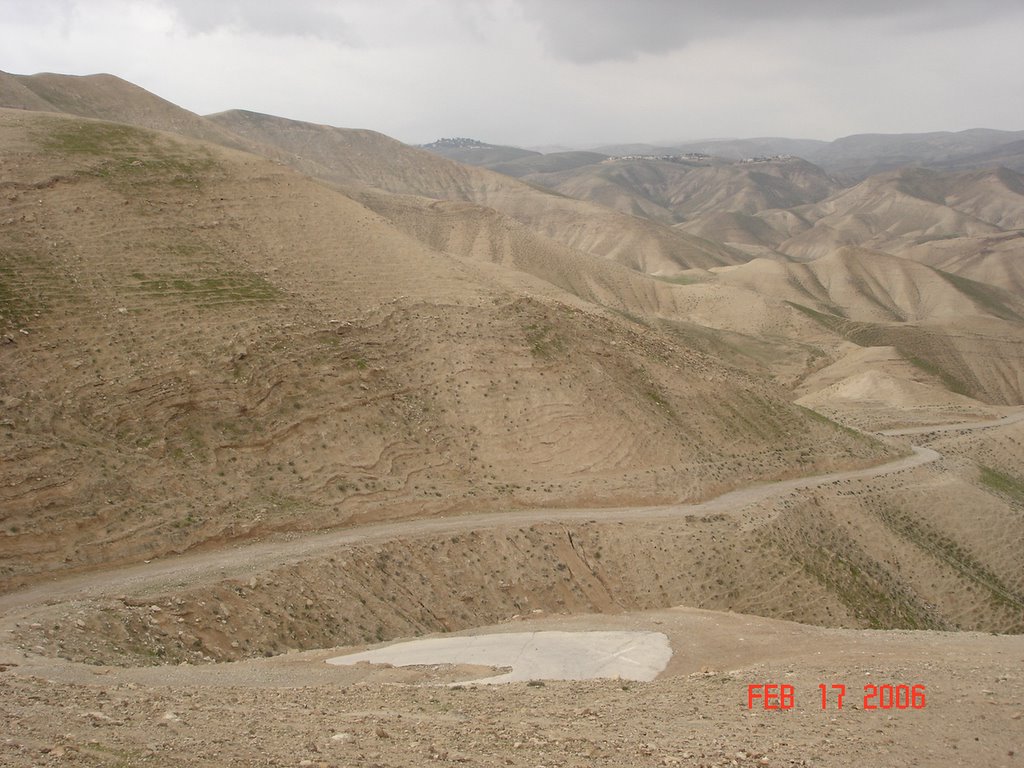
    I don't know if it was a result of my own spiritual drought, or because of the overwhelming beauty of the place, but the most moving part of our trip for me was our time in the desert of temptation. We stopped at a breathtaking overlook, high on top of a hill. If we looked out in front of us there was the "valley of the shadow of death" that David was undoubtedly looking at when he penned his most famous Psalm. Down the valley to our right was the city of Jericho and to our left, in the distance shimmering on a hill, was Jerusalem. There was, however, nothing in between. A perfect place to get lost. A perfect place to fast and pray. A frighteningly peacful place to stay.

    I wonder if in the lower moments of Christ's ministry, in Jericho with the sick or in Jerusalem with the twisted, did he long for the peace of the desert? Did Christ ever mentally go back to that place of temptation and long for the time that he had all the answers? The questions and problems were simple and easy-obvious temptation. In the desert, Satan was the clear enemy and the answers were well within reach. Life wasn't easy there, but it was obvious. The distinctions between right and wrong were as clear as those between dirt and water, life and desert.

    There is something comforting about the desert. Something centering, clarifying that we don't get when we are in the throws of normal life. Certainly life is not lush in the desert, but it is simple. Food, water and prayer are about all of your concerns in the desert. Comfortingly simple.

    This desert that I am in is in no way as profound as Christ's, nor is it as simple (or beautiful) as the desert of temptation. It is, however, seemingly obvious. Our ordination process is broken and inauthentic. My call, though questioned by the committee, has been clarified by the ensuing drought. In an odd way, I am comfortable here, more comfortable than in the lush land of affirmation.

    Times inevitably come in life when we have to walk through the desert in preparation for what is to come. Those times can be times of great clarification and simplification. There is a comfort in that...but I fear that we were not called to comfort. We were not created to live in the desert. That is why all paths to the desert inevitably lead through the desert, on to what lies ahead.

    Tuesday, February 28, 2006

    Ash Wednesday


    Joel 2:1-2, 12-17
    Matthew 6: 1-6, 16-21

    Practice Makes Perfect

    Perhaps we should start at the beginning. Before we go forward with smearing ashes on our foreheads and saying to one another, “Remember that you are dust, and to dust you shall return, repent and believe the Gospel,’ before we go forward and do that, we should go back. Allow me to start, in the beginning.
    In the beginning, when there was nothing but a shapeless, formless void, God began to create the world. God made stuff, all sorts of stuff. Trees, rocks, grass, water, fish, birds, cattle…and dust, God made them all, and they were good. But when God looked around at all of the stuff God had made, there was something missing. There needed to be something that was God’s signature work, something that could even bear the image of God within creation. But nothing could do that. Nothing in all creation could encompass the very nature, essence, image of God. If God were to make something like that, God would have to start from scratch. So God looked around and found the most basic, nothing, empty thing in the world...dust. God took the dust and began to shape and mold out of the nothingness of dust a masterpiece. This being would have a brain to contemplate, a heart to love, hands to help take care of one another and the world. This masterpiece would have the capacity to worship God rightly, to be in communion with God. So God formed humankind, and when the dust had taken shape, God breathed life into it…and you were born.
    You are God’s masterpiece in the world. You were created to bear the very image of God throughout all of creation. To those you love. To those you don’t. To your family, your coworkers, your neighbors and your enemies, you were created to bear the image of God, because you are God’s masterpiece.
    But since the beginning of creation, we have marred God’s work by trying to make something out of ourselves. You and I have willfully filled our lives with love of self, with pride, with envy, with hate, with callous hearts. In our attempts to make something out of ourselves, we have taken God’s masterpiece and tarnished it. As a result, you and I don’t always bear God’s image in the world. We don’t love our neighbors. We don’t love our enemies. We don’t love our co-workers. We often don’t even love our families. We rape creation for our own exploitation, we kill others in the name of peace and we see no higher authority than our own feelings or the whims of our hearts. As long as we try to make something out of ourselves, God can do nothing with us. But if we can somehow yet again become nothing, dust, there’s hope.
    After all, God’s masterpieces area made out of nothing. The church calls it “ex nihilo,” meaning that God’s creation came from nothing, from scratch. Lent is the time of year that we intentionally seek to empty ourselves, to become as much like nothing as possible, so that God can yet again make masterpieces out of us. The tools that we use are what we call the disciplines of the faith. We do things like pray, fast, give alms, confess, and repent. But there is a a danger in doing these things. These, too, can become something. We can take these disciplines, designed to empty us, and fill ourselves with them. Worse yet, we can seek to be seen as religious, trying yet again to make something out of ourselves. When our disciplines become something, they are useless in God’s hands. Discipline, Jesus says, are never about being seen by others. When you pray, go behind closed doors, so that God can make something out of your prayers. When you give alms, do so in quietness, as though it’s nothing, so that God can make something out of it. When you fast, act like nothing is happening, so that in your emptiness, God can fill you. The disciplines, Jesus says, are not another way to make something out of yourselves. They are a way to empty yourselves. To make us nothing. As dust-like as possible. After all, God’s masterpieces are made out of nothing.
    The Lenten disciplines are designed to empty us, to strip us of all those things that are something to us, so that God can yet again make masterpieces out of us. It is good news, this evening (afternoon), when you are smeared with ash and told to remember that you are dust, and to dust you shall return. God makes masterpieces out of nothing. Pray to become dust, even this Lent. Pray that God takes the disciplines of the faith, and so empties you that you are able to lay dead with Christ on Good Friday, on Holy Saturday and in the tomb on Easter Sunday, divested of everything, emptied of all the trappings in our lives, made, yet again, nothing, as dust-like as possible. Because even now, just like in the beginning, God is looking for some dust to create a masterpiece. Remember that you are dust.

    Saturday, February 25, 2006

    The Transfiguration


    So my goal for this blog is to comment on the lectionary text each week. A venue, as it were, for me to engage the text and to have the text engage me. On the weeks that I happen to be preaching, I will simply post my sermon. The Gospel this week is Mark's account of the Transfiguration.

    Overwhelming Glimpses
    Mark 9: 2-13
    Well, we made it back safe and sound from our trip to the Holy Land and let me just be the one to tell you that words fail. Twenty-four people from both our church and Sunrise UMC in Holly Springs left about two weeks ago for a ten day trip to Israel/Palestine where we made a pilgrimage to the places where Jesus was born, where he walked on water, where he preached his most famous sermons, to where he wept over the city of Jerusalem, where he was crucified, where he was buried, and where he ascended into heaven. The landscape in Galilee was breathtaking, the valley of Armageddon was awe inspiring, and Jerusalem was simply captivating. Superlatives don’t do that place any justice. Simply put, words fail.
    Which is a problem if you happen to be a preacher. Words are my trade. Words are often all I have, whether I am counseling someone or going to see someone in the Hospital or standing to speak on Sunday morning, when you boil it down, all I have to offer are words. One of my professors in seminary said that he always wore as many vestments and holy looking things as he could because besides that, words were all he had! Words are my trade. And during this trip, words failed!
    I was asked over and over again during the trip to offer some words for the group, just on the spot. Our guide, a local Arab Christian, would give us the historicity of the place where we were standing and almost like clock-work, when he had exhausted all the Biblical and historical data on any given location, he would turn to me and say, “Pastor, do you have some words for us?” And, like an idiot, I would start stammering and bumbling and try and pull up something to say which would nicely and succinctly wrap up the theological, historical and spiritual significance of an event or place. Inevitably my words were lacking and I would end up saying almost anything, which more often than not turned out to be nothing, in order to fill the silence. How do you “wrap up” the healing of Lazarus in Bethany, or the church of the Beatitudes or, God help me, Golgotha? Words fail.
    Thankfully, I’m not the first bumbling disciple trying to fill the silence with failing words. St. Peter has blazed a trail before me. Peter, one who was never lacking for words, and the one to whom the rest of the disciples looked for leadership, is on his way to Jerusalem with Jesus in this morning’s Gospel text. Up to this point, they don’t know exactly why they are going, except that it is going to be the time of the Passover, so all Jews were headed up that way. And on their way to the Holy City of Jerusalem, Jesus takes his favorite three disciples and leads them to a mountain set apart. Standing there on the mountain with Jesus, Peter, James and John see an indescribable event. Words fail. Jesus is changed, morphed…transfigured before them. Mark tells us that his clothes became “dazzlingly white, like no one on earth could bleach them.” And, to top that off, Moses and Elijah are standing there with Jesus. The two most important people in the history of God’s working with the world, Moses, the writer of the law, and Elijah, the greatest of the prophets, both standing with Jesus testifying that he is the culmination of both the law and the prophets. Just when it is getting good and the disciples are taking in this overwhelming glimpse into what God is up to in the person of Jesus Christ, Peter feels the need to fill the holy silence with some bumbling words. “Lord, it is good for us to be here. Let us build three dwelling places, one for you, one for Moses and one for Elijah.” At this point in the story, just in case the reader misses the invasiveness of Peter’s comment, Mark inserts, “He didn’t know what he was saying for they were terrified.” Just before St. Peter’s interrupting words jar everyone out of the vision, a voice from the cloud speaks, “This is my beloved Son, listen to him.”.
    Let Saint Peter and I be the ones to tell you first to tell you that sometimes holiness is best met with silence. Twice in this text, we are exhorted to be quiet as disciples. First, God speaks from the cloud and tells the disciples to listen to Christ. It’s hard to listen if you’re talking. Second, Christ says as much when they are all walking off of the mount of Transfiguration. He tells Peter, James and John not to say anything about what just happened until after the resurrection. “Keep quiet,” he says. In the face of the most holy places, in the presence of the most Holy One, words fail. Silence, somehow, does not.
    It seems to me that silence is a rare commodity these days. We are not a good people at being silent. Perhaps that is because ours is a world filled with noise. Our days start with a jolt from an alarm clock. In the car, the radio drones on in the background. At work, conversations from others down the hall, phones ringing, emails buzzing, voicemails beeping, keep our ears from resting. When we get home, the Television is often on in the background just to fill the silence, and we fall asleep, having crowded out every silent moment of our day.
    This has bled over into our holy moments with God. Look how wordy our worship is…prayers, songs, readings, sermons. Our evangelical efforts are often wordy, us trying to convince others why they should repent and believe the Gospel. Christian rhetoric is batted around in any arena, be it political or otherwise, until the words are useless and meaningless. Mind you none of these things are bad in and of themselves. Just like Peter’s idea to build the tents for Jesus, Moses and Elijah was not necessarily bad. It was just not best. Silence was best then in response to God. And, at times, silence is best now as our response to God.
    On Wednesday, we will gather for Ash Wednesday. And with that, we will officially begin Lent. I have a suggestion for our Lenten life together this year. I propose that we, as a church, practice the age old discipline of silence. I propose that we practice it both collectively and individually. After all, when words fail, silence, somehow, does not. I propose that we practice being silent so that that our speaking might be good. Being a people who are comfortable with silence is to be a people of faith, who belive that our words are not nearly as important as the Word incarnate, who lived and dwelt among us. Who was the very glory of God, and gave us a glimpse of our hope in his own transfiguration. I propose that we inculcate the discipline of silence during lent, so that when words fail because the pain is too much, or the need is too great, or the problem is too large, we will be equipped to be silent and listen. Listen for the ways in which God is transfiguring the world, listen for the ways that God is redeeming our suffering, in our brokenness, and our pain. God is working to transfigure all of the world, not just to some set apart on a mountain, but to all who are in need of transformation. But if we are going to be a part of that, we are going to have to be silent and listen. Like Elijah, who heard God in a whisper.
    Here’s my proposal. First collectively. I propose that we allow a time of silence in our worship. Not too long, but long enough to let the Word sit on us. So, after the sermon, I propose that we all just sit with the word that was just read and proclaimed before rushing into our next act of worship. In that time, in the silence of the wake of the Word, listen. The sermon may just be beginning. Secondly, indivudaully. I propose that we all take a vow of silence daily for the duration of Lent to practice our response to God. If you can do 30 minutes, great. If you can do 10, or even 5, that’s great too. But during those times of silence, I propose that we practice silence. No speaking, no entertainment, no phone calls, just silently sitting before the transfigured Christ. In the still cloud of silence, I am sure that God will speak yet again, “this is my beloved Son, listen to him.”

    Friday, February 24, 2006

    Reluctantly Blogging


    Well, this is it...my first blog. My introduction to the "world wide web.," as the kids call it. My friend Aho (see a link to his blog over on yon sidebar) has a t-shirt that reads "What you like, I liked 5 years ago." My bet is that his first blog was exactly 5 years ago...oh, and his final blog was probably 5 minutes ago. Anyway, here I am blogworld and I'm here to stay...at least until Aho tells me what to like next. Take a good look, it's the best thing going today.